A knowledge factory needs a gate
Agents can learn from corrections and keep company knowledge current. A refund, payment or contract still needs a person to release it. Here is the gate.
Harrison Chase’s essay on the knowledge factory gets something important right: agents need company knowledge that stays current.
The essay puts it plainly: "In order to make AI work for your company, you need to collect, curate, and maintain a representation of that knowledge to pass to agents."
That knowledge includes how work gets done, how the business works, and where to find current data. It cannot simply be handed to an agent once and left alone. As people and agents work, they find gaps and errors. Someone, or something, needs to notice those gaps and update what the agent can use.
The essay describes a way to do that. Agents flag gaps or errors. A curator agent reads those flags alongside records of the work and source material, then updates stored knowledge. Procedures can be kept as skills, including SKILL.md files.
One example makes the loop concrete. A finance lead corrects a report. Later, the curator uses that exchange and a flagged data change to update skills. The correction can help future work, rather than staying inside one exchange.
I agree with that direction. A useful agent should be able to learn from corrections and use maintained knowledge. I also think there is a piece to add: a gate for actions that cannot be undone.
Learning makes an agent better at a task. It does not make every action safe to take alone. These are different questions. One asks whether the agent has the knowledge to prepare the work. The other asks who decides when an irreversible action goes ahead.
A skill can teach an agent how to prepare an action. A person should release it when the action cannot be undone.
Consider a refund. An agent can prepare it and hold it for review. Once the refund is sent, the step has happened. A person should decide whether to release it.
The same distinction applies to a payment. The agent can prepare the payment. The gate belongs before the payment is released, with a person making that decision.
A disclosed record is another example. An agent can prepare the record for review. Before it is disclosed, a person should decide whether to release it.
A signed contract belongs at the gate too. An agent can prepare a contract. A person should decide whether it is signed.
In each case, the agent can do useful work before the decision. The person does not need to prepare the whole item to have a say at the point that matters.
These examples do not call for a person to approve every part of the work. That would put the gate in the wrong place. An agent that asks about everything is useless to a busy team.
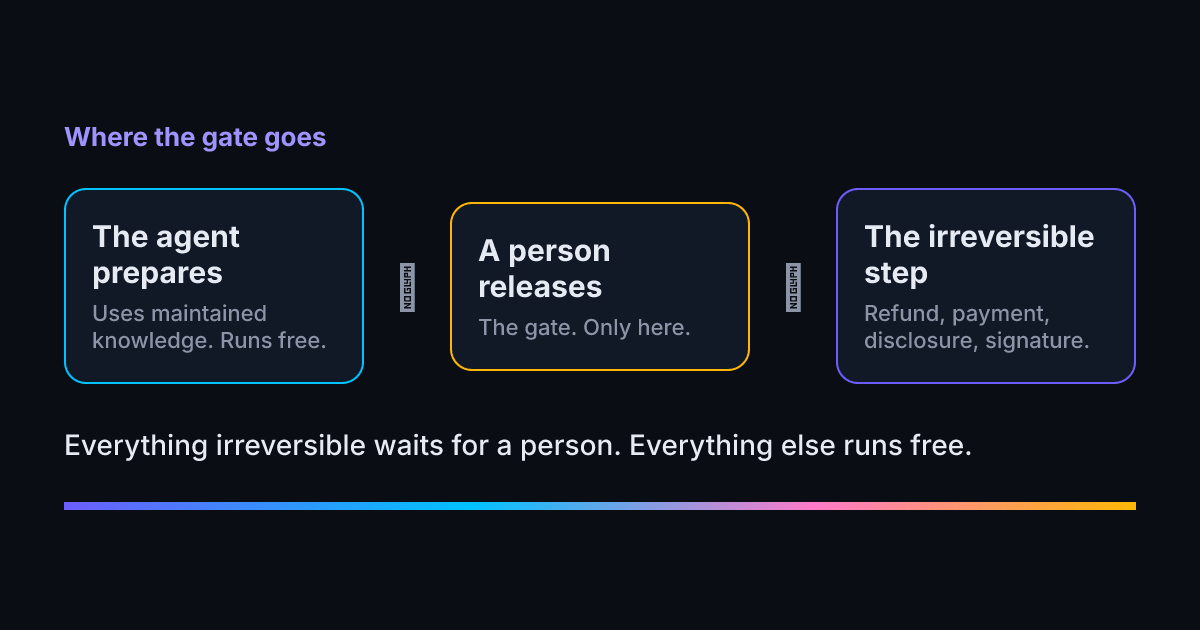
The gate should sit only in front of the step that cannot be undone. The agent can work freely on everything else: using maintained knowledge, preparing the work, and flagging gaps or errors along the way. The person’s decision comes when it is time to release the irreversible action.
That is the rule I use: everything irreversible waits for a person, everything else runs free.
AI can hold a refund, but only a person can release it.
Sidra Miconi is the founder of AgentGlass.
Sources (read on Nov 21, 2026)#
- Harrison Chase, LangChain: the knowledge factoryRead on Nov 21, 2026